
Short answer
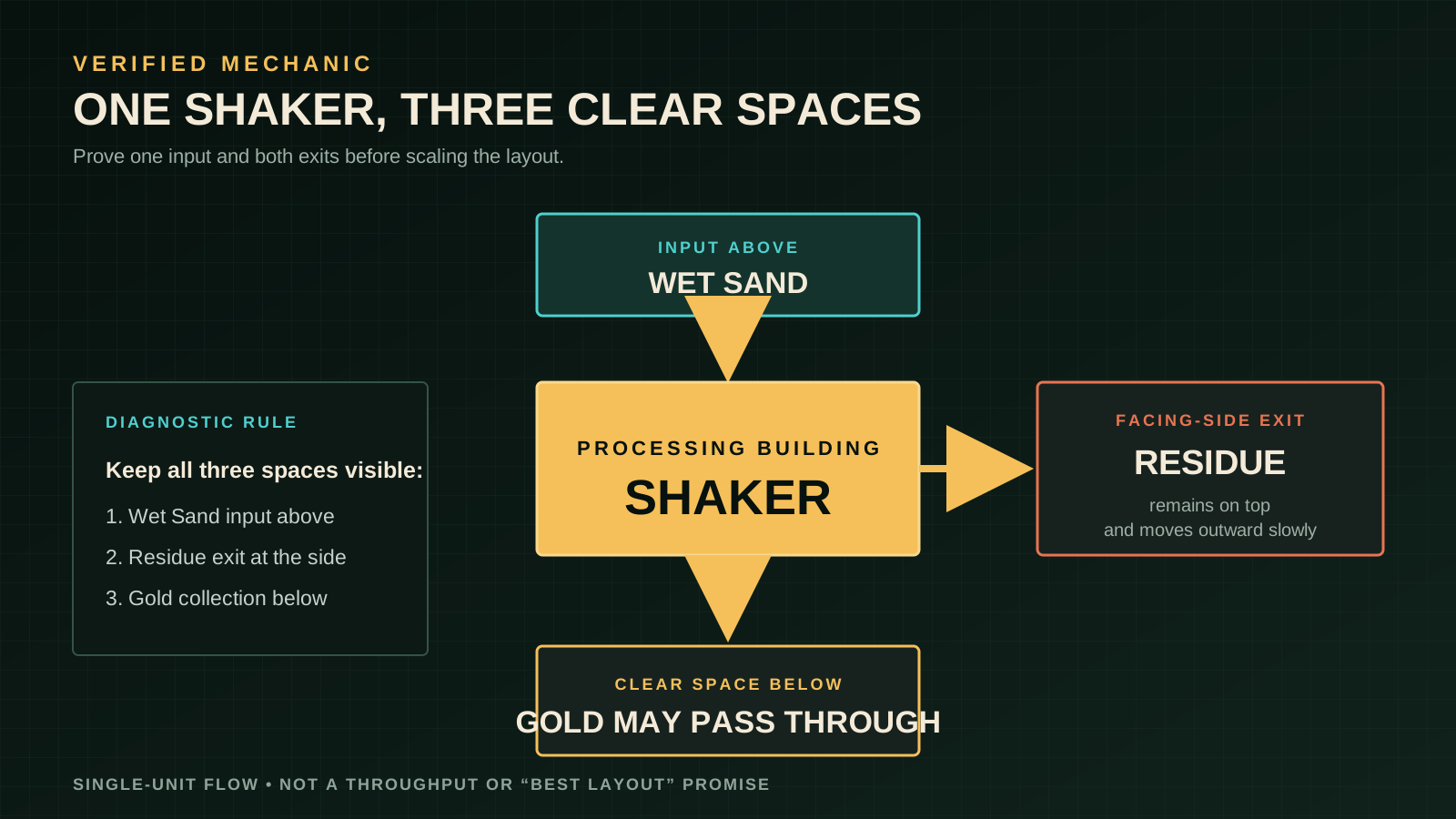
The Shaker is an early processing building: place Wet Sand on top, let it produce Residue, and collect the Gold that can pass through the building. The official Shaker page says each Wet Sand becomes Residue and has a chance to also produce one Gold; it also warns that non-Gold solids can become trapped in the body. This guide covers those verified mechanics and deliberately leaves complex high-throughput layouts unverified.
Verified one-unit setup
- Unlock the Shaker in the current Research tab. The checked Research snapshot places it in Tier 1 and shows 20 Gold; recheck that value after updates.
- Make Wet Sand by bringing Sand and Water together.
- Place Wet Sand on top of the Shaker or feed it through a short, visible solid route.
- Leave the bottom open for Gold and a side path for Residue, which is pushed outward slowly.
- Run one input at a time and confirm which material leaves each side before copying the shape.
The official Wet Sand page documents the Wet Sand reaction and its Shaker by-products. The Shaker does not require a hidden recipe or an imported layout to test.
What the Shaker actually does
The official page describes Wet Sand becoming Residue with a 25% chance to also drop one Gold. Gold is the only solid pixel that passes through the Shaker; Residue remains on top and is slowly pushed in the facing direction. The Shaker blocks a non-hovering player, but it does not block liquids or gases according to the entity page.
Feed direction and receiving space matter. A clear lower collection point prevents Gold from backing up, and a visible side path makes Residue easier to inspect. If a non-Gold solid is dragged into the Shaker body, remove it manually rather than adding more input.
Scaling boundary
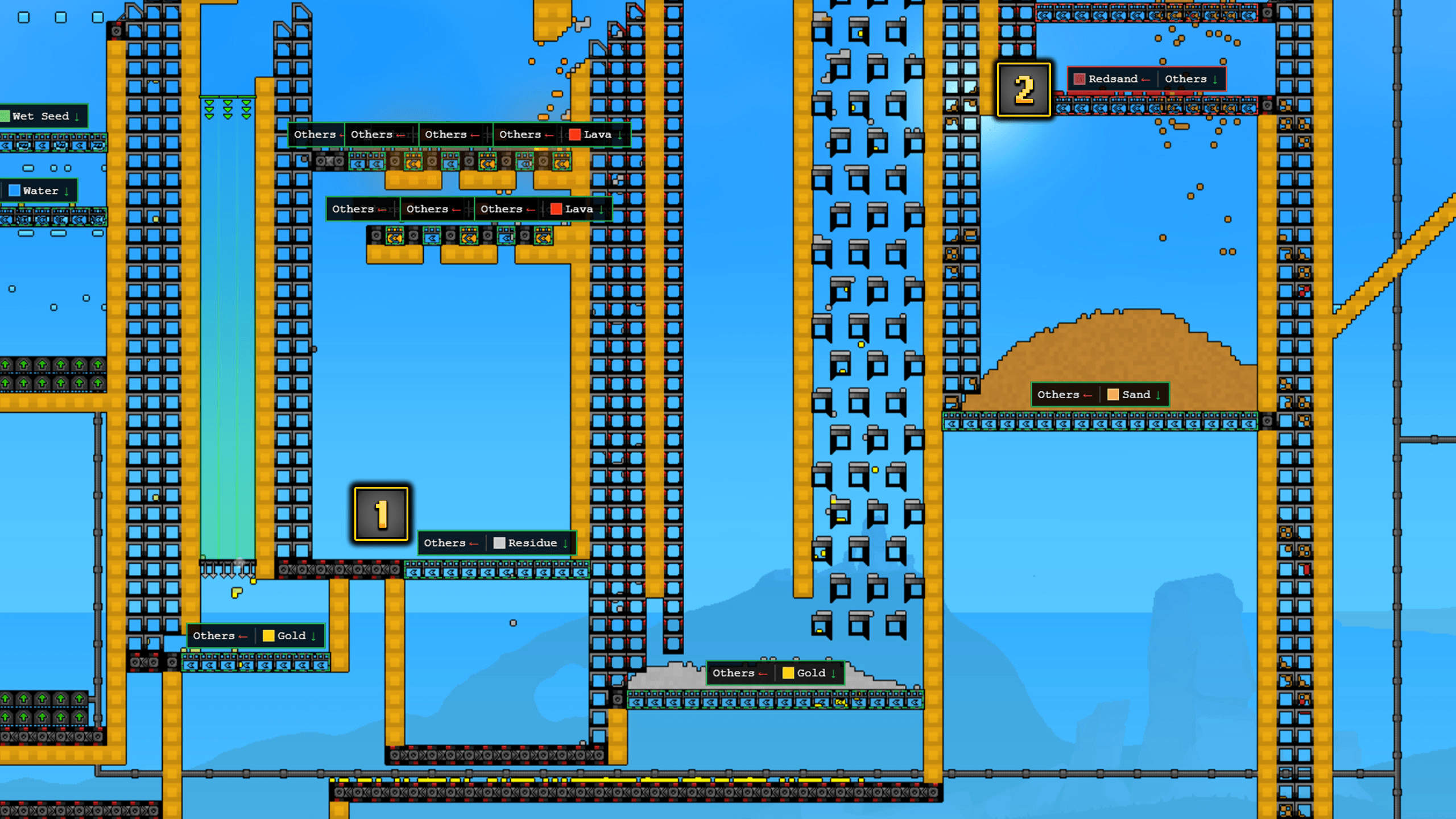
A simple diagonal or multi-Shaker arrangement may be useful for experimentation, but a complex high-throughput layout is not verified by this page. Do not publish a fixed Shaker count, guaranteed Gold rate, or best staircase until it has been reproduced in the current build with a dated measurement.
If you need more capacity, duplicate the one-unit test with independent input and output space. Treat any shared-belt or dense staircase as a local experiment and keep its status “to verify.”
Troubleshooting
- No Gold appears: one Wet Sand input does not guarantee Gold; inspect the output after several tested inputs and confirm that the bottom is not blocked.
- Residue piles up: the Shaker pushes Residue slowly; clear the facing side and provide a receiving route before adding another feeder.
- Wet Sand does not process: confirm that the material is Wet Sand, that it reaches the top, and that a different solid is not trapped in the body.
- The route jams: check conveyor direction, launcher receiving space, and whether the next machine blocks the output.
- A copied high-throughput layout stalls: return to one Shaker, isolate each input/output, and treat the larger arrangement as unverified.
Common mistakes
- Expecting Gold from every Wet Sand input even though the documented output is chance-based.
- Blocking the lower Gold exit or the facing-side path used by slowly pushed Residue.
- Dragging a non-Gold solid into the Shaker body and continuing to feed the jam.
- Calling a dense staircase or shared-belt design “no-clog” without a dated current-build test.
- Reusing old Slag terminology for the current Wet Sand-to-Residue process.
FAQ
Does the Shaker process Slag into Gold?
The current official Shaker page describes Wet Sand becoming Residue and sometimes Gold. Do not substitute Slag terminology from an old guide.
What is the Kinetic Press connection?
The Shaker’s Residue can be ignited into Burnt Residue. The current Kinetic Press then processes Burnt Residue into Gold and Seed when its drop-height condition is met. See Lava for a documented ignition route and Materials for the naming boundary.
How many Shakers should I build?
There is no current universal count in the official source. Start with one verified unit, then add independent units only after input, output, and blockage behavior are clear.
Why is the Gold rate different from an old guide?
The official page describes a chance-based Gold output, and the game is WIP. Recheck the current version instead of treating a demo-era rate as permanent.
Sources and related links
Sources checked 2026-08-24: official Shaker page, official Wet Sand page, official Research page, official Burnt Residue page, and official Beginner’s Guide.
Continue to Beginner Tips, Tier List, Materials, and Blueprints for adjacent setup questions.