
Category:Materials
Official English names are retained so they match the game reference and source pages.
Amethelis
Official WikiAuralite
Official WikiAuralite Crystal
Official WikiAurixite
Official WikiBurnt Residue
Official WikiCinder
Official WikiCopper
Official WikiCopper Ore
Official WikiCrackstone
Official WikiDepleted Steam
Official WikiDirt
Official WikiDry Amethelis
Official WikiDune
Official WikiFlorin
Official WikiFlorinol
Official WikiFlorinol Soil
Official WikiFlower
Official WikiFluxite
Official WikiFrostbed
Official WikiGold
Official WikiIce
Official WikiIndestructible
Official WikiLava
Official WikiLimestone
Official WikiLiquid Copper
Official WikiLiquid Gold
Official WikiMooncrystal
Official WikiMoonhop
Official WikiMoss
Official WikiPrismaline
Official WikiPrismite
Official WikiPuff
Official WikiRedsand
Official WikiRedsoil
Official WikiResidue
Official WikiSand
Official WikiScoria
Official WikiSeed
Official WikiShatterstone
Official WikiSnow
Official WikiSolidite
Official WikiSteam
Official WikiStone
Official WikiSunsand
Official WikiVine
Official WikiVoid Husk
Official WikiVoid Juice
Official WikiVoid Petal
Official WikiVoid Seed
Official WikiVoidbloom
Official WikiWater
Official WikiWet Sand
Official WikiWet Seed
Official WikiShort answer
Sandustry’s materials change by state, density, interaction, and processing role. Use this page as a maintainable index of current material families and follow the linked entity pages for mechanics. The old supplied density chart is not a current authority: it uses outdated names and places Lava incorrectly for the current reference. Do not use that image to infer recipes, routes, or a permanent density order.
How to use this reference
The official Category:Materials is the maintainable source of truth for the materials catalog. It currently lists 53 pages, including materials that are not part of the opening factory. Because the category and game are WIP, this page groups materials by job instead of freezing a copied density table.
When a material behaves unexpectedly, identify its exact name, state, and next process. Then open the current entity page or Research before changing a factory route.
Steps for a current lookup
- Read the material name in the current UI or with the Material Scanner.
- Classify its state and whether it is a resource, by-product, gas, liquid, or terrain block.
- Open the matching current entity page from Category:Materials.
- Check the next process and receiving space before changing the factory.
- Record the game version when a behavior differs from an older guide.
Early solids and slushy inputs
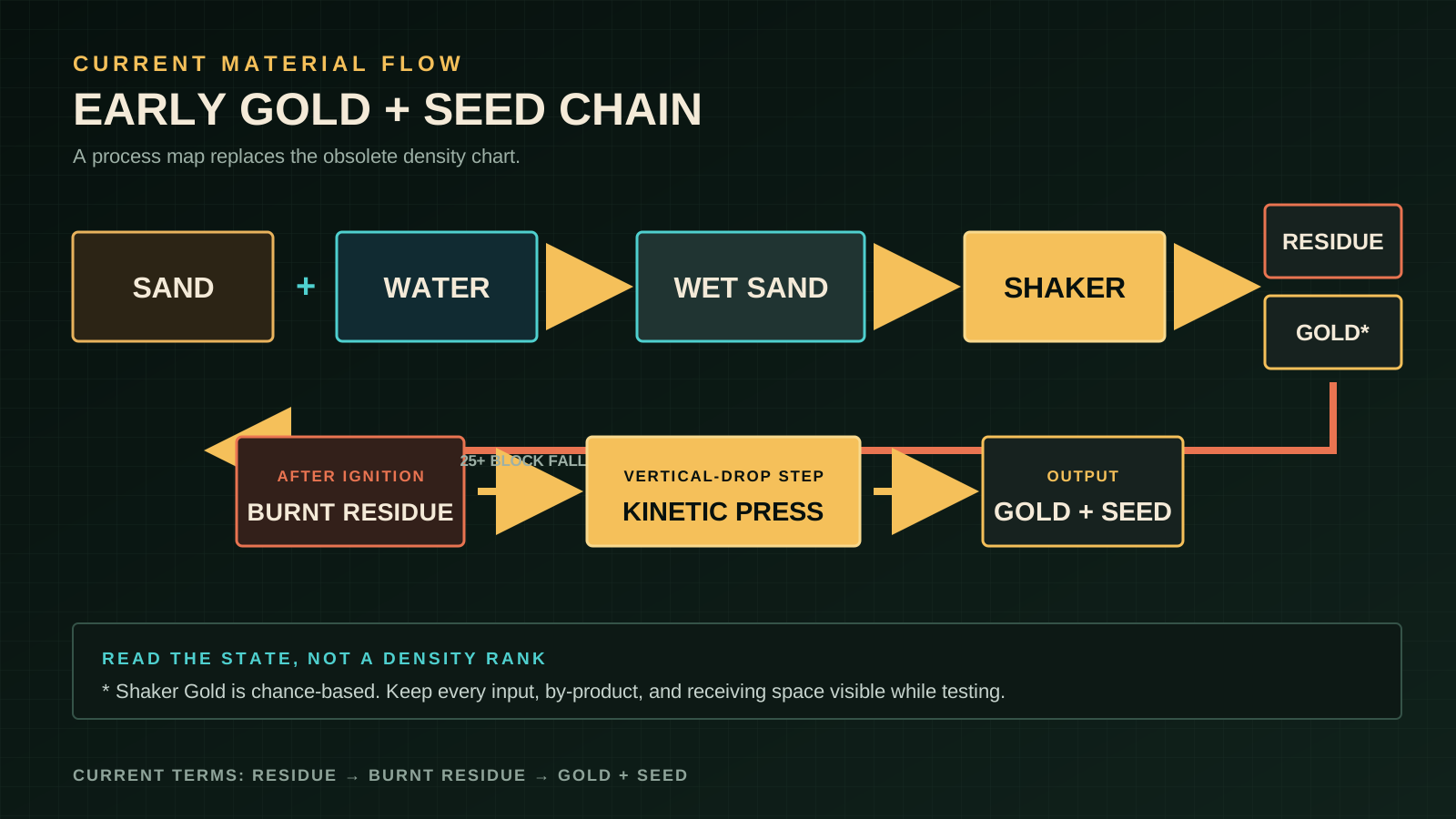
- Sand is the starting solid for the first Wet Sand loop.
- Wet Sand is made when Sand and Water touch and is processed by the Shaker.
- Residue is the Shaker by-product and can be ignited.
- Burnt Residue is the current Kinetic Press input; the press produces Gold and Seed when the required drop-height condition is met.
- Gold is used to unlock Research.
- Seed becomes Wet Seed when Water is absorbed, then feeds later plant processing.
Do not replace Burnt Residue with “Burnt Slag” in a current Kinetic Press explanation. The official current entity pages use Residue, Burnt Residue, Gold, and Seed.
Plant and void chain
- Flower and Amethelis belong to the plant and energy paths.
- Redsand, Void Petal, and Voidbloom belong to the later void chain.
- Voidbloom is processed by the Flux Emanator into Fluxite; check the current input and available space around that building.
- Fluxite upgrades tools, weapons, and drones and can be found naturally before later generation.
See Fluxite and Flux Emanator instead of inferring a recipe from a chart.
Heat, cold, liquids, and gases
- Water wets Sand and Seed, flows downhill, and can become Ice or Steam through documented interactions.
- Steam rises and may condense at the sky into rain; a Condenser is a separate processing route.
- Snow can combine with Water to form Ice and can freeze Lava.
- Ice can melt into Water.
- Lava is a hot liquid found in underground caverns; it becomes Scoria with Snow and Cinders when the Scoria is destroyed.
- Scoria and Cinder are the solid handling stages of the Lava relocation loop.
Use Water and Lava for flow, state changes, and containment. Do not turn a material interaction into an unsupported throughput claim.
Terrain and world materials
Crackstone and other terrain entries are not automatically production inputs. Before putting a world block into a factory chain, confirm whether the current entity page describes a resource, a terrain obstacle, or a building interaction. The appropriate tool may matter more than density.
Live alphabetic catalog — snapshot checked 2026-08-28
The official Category:Materials is a live catalog snapshot. The names below remain in their official English form; this is not density, recipe, throughput, or processing data. Follow an entity link for the current page and re-check the category when the game or Wiki changes.
The verified catalog above renders all 53 names in alphabetical order.
Version and old-chart warning
Last verified against the official pages on 2026-08-24. The category and Research page are WIP surfaces. The earlier density image and list in this project should be treated as archival material only; in particular, its Lava position is wrong for current guidance. If a screenshot, demo guide, or community post uses Slag/Spores for the Kinetic Press, re-check the current Kinetic Press and Burnt Residue pages.
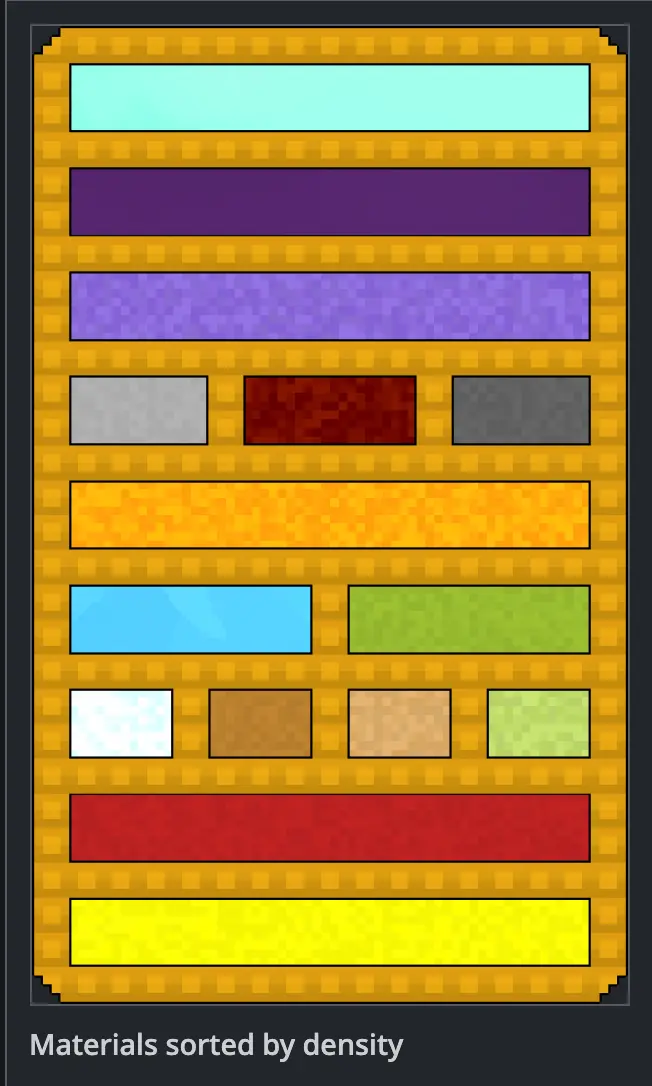
Use the chart only to recognize the older visual reference. The current material-flow diagram and linked official entity pages above are the actionable guidance.
Troubleshooting
- A recipe does not work: verify the exact current material name and state; do not rely on an old density order.
- The Kinetic Press is blocked: feed Burnt Residue from the documented drop height and provide room to clear non-qualifying inputs.
- A Lava line is stuck: Lava cannot use ordinary Pipes; convert it to Scoria and Cinders first.
- A Water line leaks: inspect corners and gaps because liquids can slip through an unblocked corner.
- A Fluxite upgrade is unavailable: check Research and Factory Level; Fluxite and Gold serve different progression systems.
- A category entry is missing: the official catalog changes; check the current Category:Materials page rather than restoring a stale chart.
FAQ
Is the old density chart still authoritative?
No. It is retained only as archival context. It has outdated terminology and an incorrect Lava placement for current guidance. Use the current Category:Materials and entity pages.
What does the Kinetic Press consume and output?
The current official page says Burnt Residue falls onto the press and becomes Gold and Seed when the height condition is met. It is not the old Slag-to-Spores mapping.
Is there one complete material list for every factory?
The official category is the live catalog, but not every entry is part of the opening loop. Follow the current entity page and Research entry for the material relevant to your save.
Where should I start?
Read Beginner Tips, then open the specific Water, Lava, or Fluxite guide for the next mechanic.
Sources and related links
Sources checked 2026-08-24: official Category:Materials, official Research page, official Wet Sand page, official Kinetic Press page, official Burnt Residue page, official Water page, and official Lava page.
Continue to Beginner Tips, Tier List, Shaker Setup, Water, Lava, and Fluxite.